DEXHQ Apply for the beta
Private beta · Now accepting applications

Run your whole brand
on one system.

DEXHQ brings inventory, purchasing, orders, marketing, and royalties together — computed from one source of truth.

Built to scale you from $1M to $20M+.

Small batches. Hands-on onboarding. Founding-member pricing at launch.

The problem

Your stack has a founder-shaped hole in it.

Past $1M a year, the standard playbook is a dozen disconnected tools — and you become the integration layer.

01

One tool for inventory. Another for orders. Another for ad reporting. A spreadsheet for royalties. None of them agree with each other.

02

Evenings spent reconciling numbers between systems instead of running the business.

03

Forecasts that ignore stockouts. Cash surprises when supplier deposits come due. Royalty statements built by hand every quarter.

04

The big platforms are built for departments and teams — the stage you haven't reached yet. Nothing is built for the founder running it all.

The integration tax: growing brands routinely pay thousands per month across 10–15 tools — then spend hours every week gluing the numbers together by hand.
The answer

One source of truth.
Every number agrees.

Every module in DexHQ reads one shared layer of sales, cost, and stock facts. Not synced. Not reconciled. The same rows.

Sales facts Forecast Buy list Cash Ad performance Royalties

When your buy list, your ad reporting, your cash forecast, and your royalty statements are computed from the same data, they can't disagree — so you stop auditing your tools and start trusting your decisions.

The modules

Five departments. Zero headcount.

Start with what hurts. Turn on the rest as you grow.

Inventory & Purchasing

StockDex

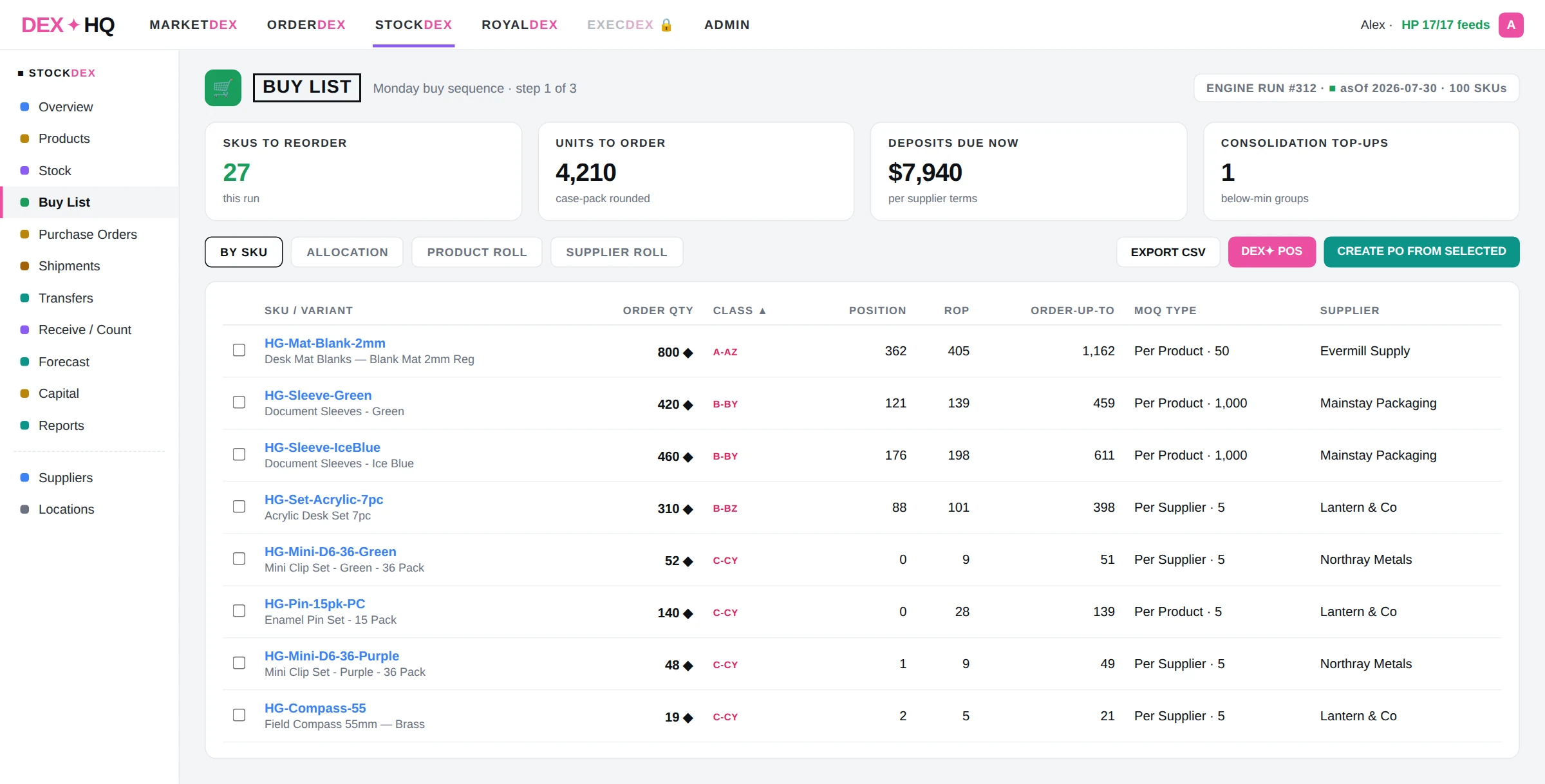
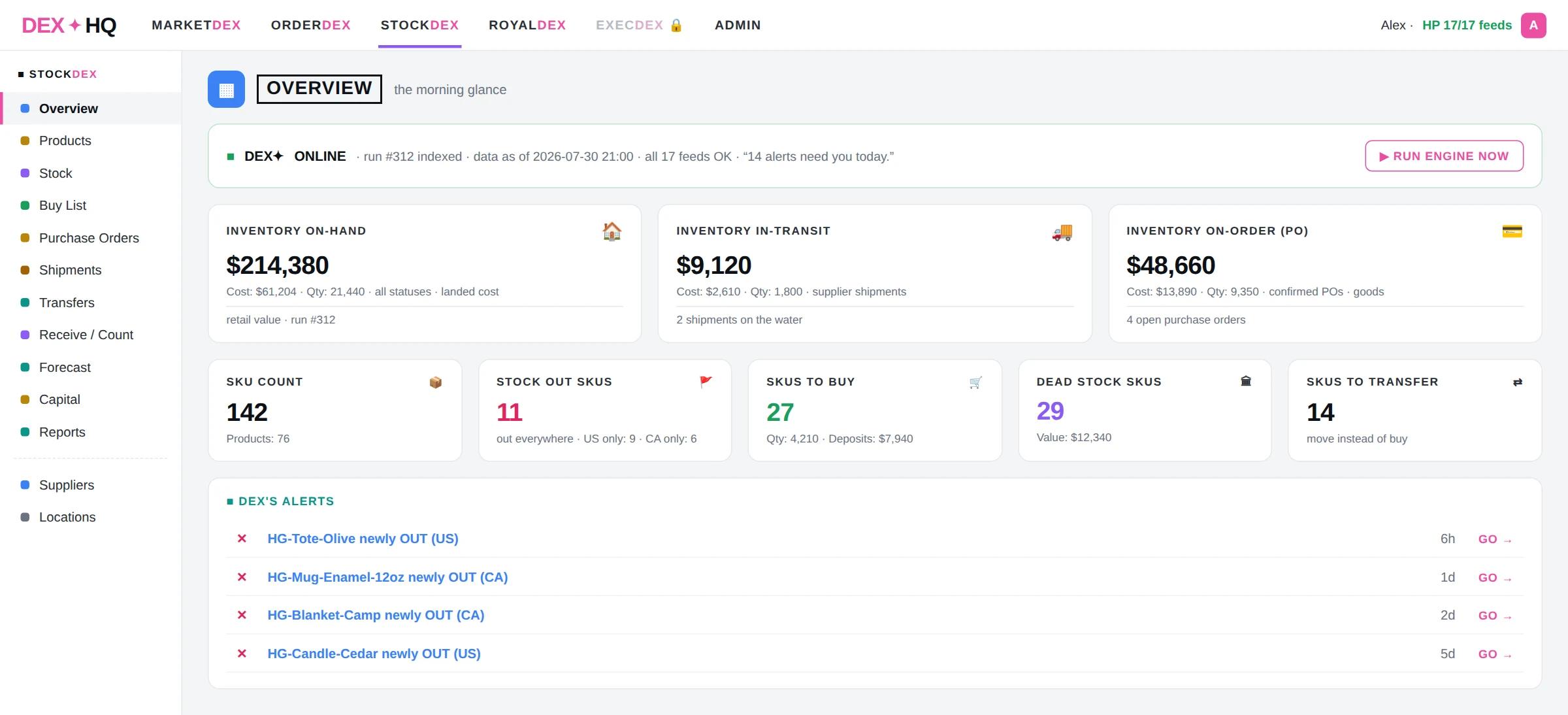
The planning brain: what to buy, when, from whom — and what it does to your cash.

  • Seasonal demand forecasting that corrects for stockouts — out-of-stock weeks don't poison next season's plan
  • Safety stock & reorder points by ABC-XYZ class
  • Buy lists consolidated by supplier minimums & case pack
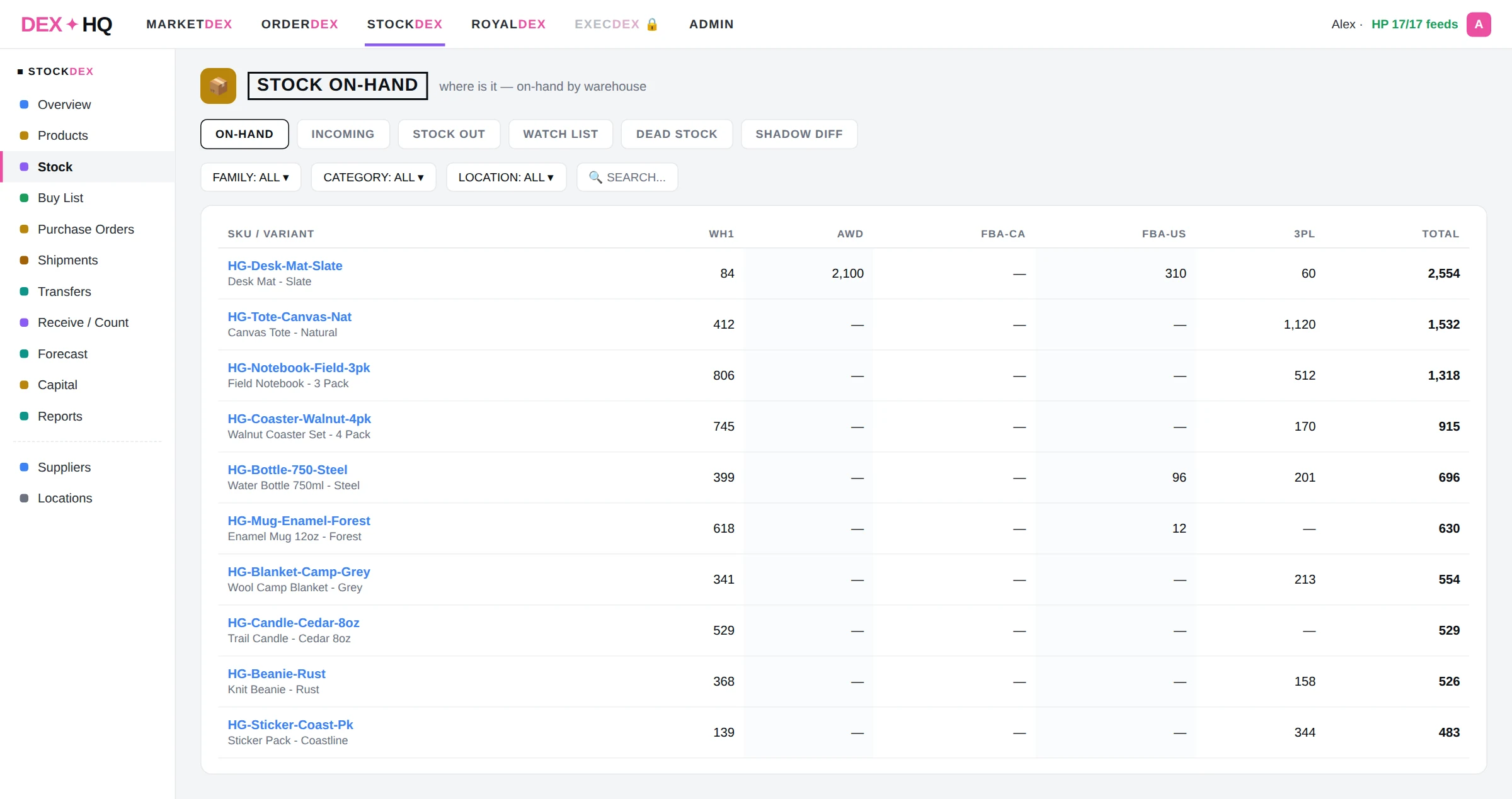
  • Dead stock with trapped-dollar value, transfer suggestions, capital view
Orders & Fulfillment

OrderDex

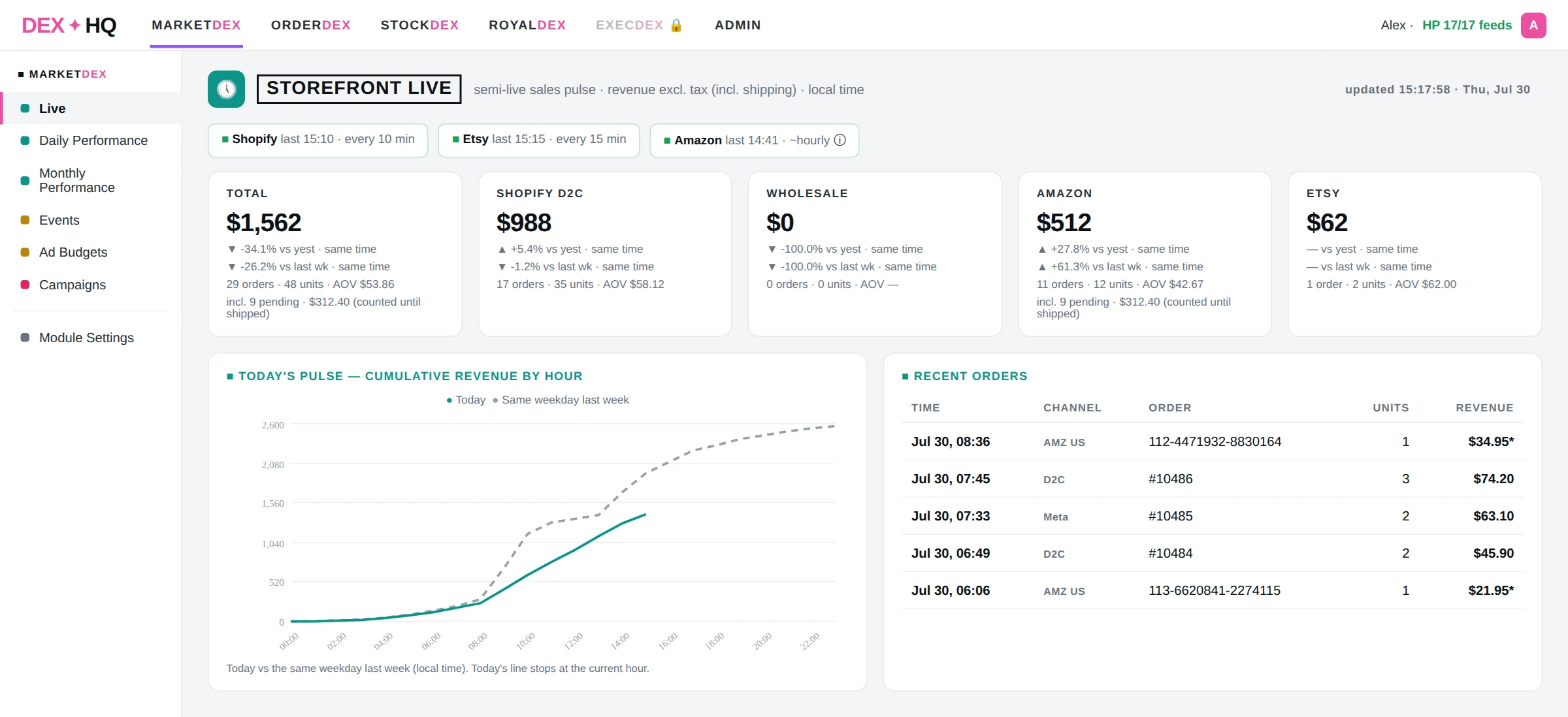
Every channel's orders in one queue — Shopify, Amazon, Etsy, wholesale.

  • Unified order hub with exception tracking
  • Split shipments, made-to-order queues, carrier rate shopping
  • Privacy-first customer data handling built in
Marketing Performance

MarketDex

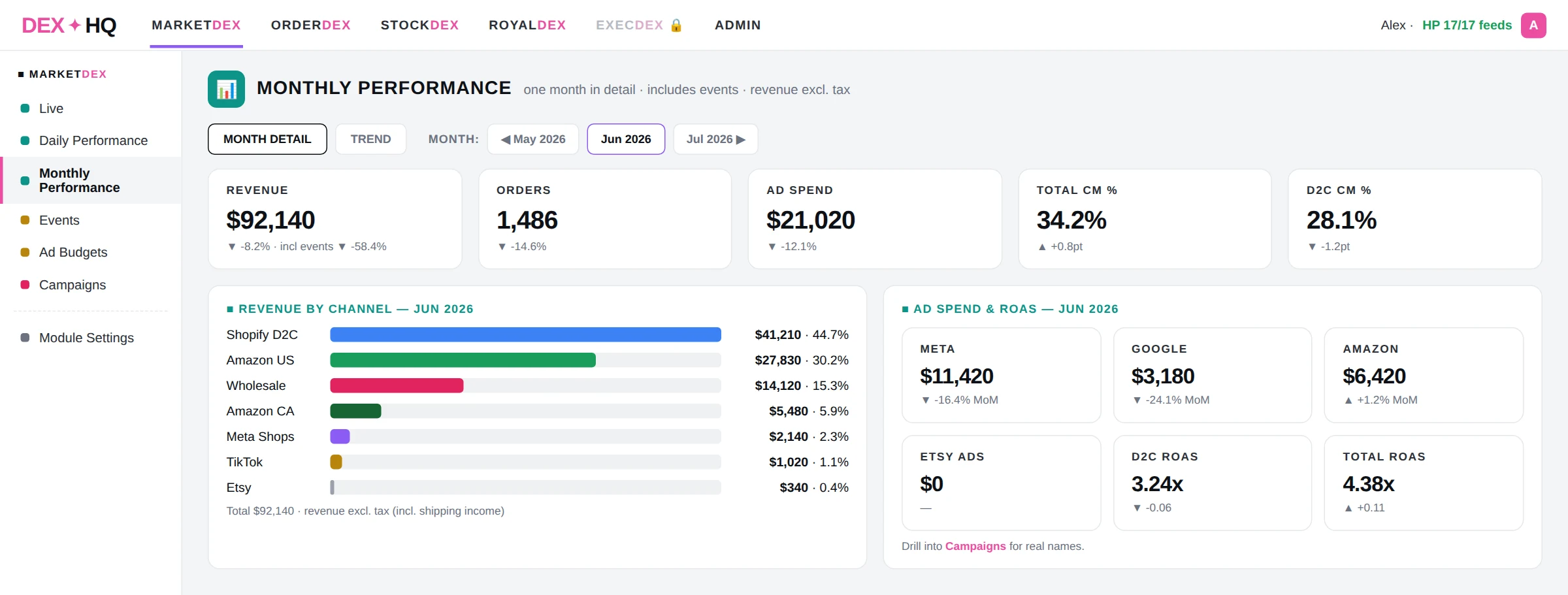
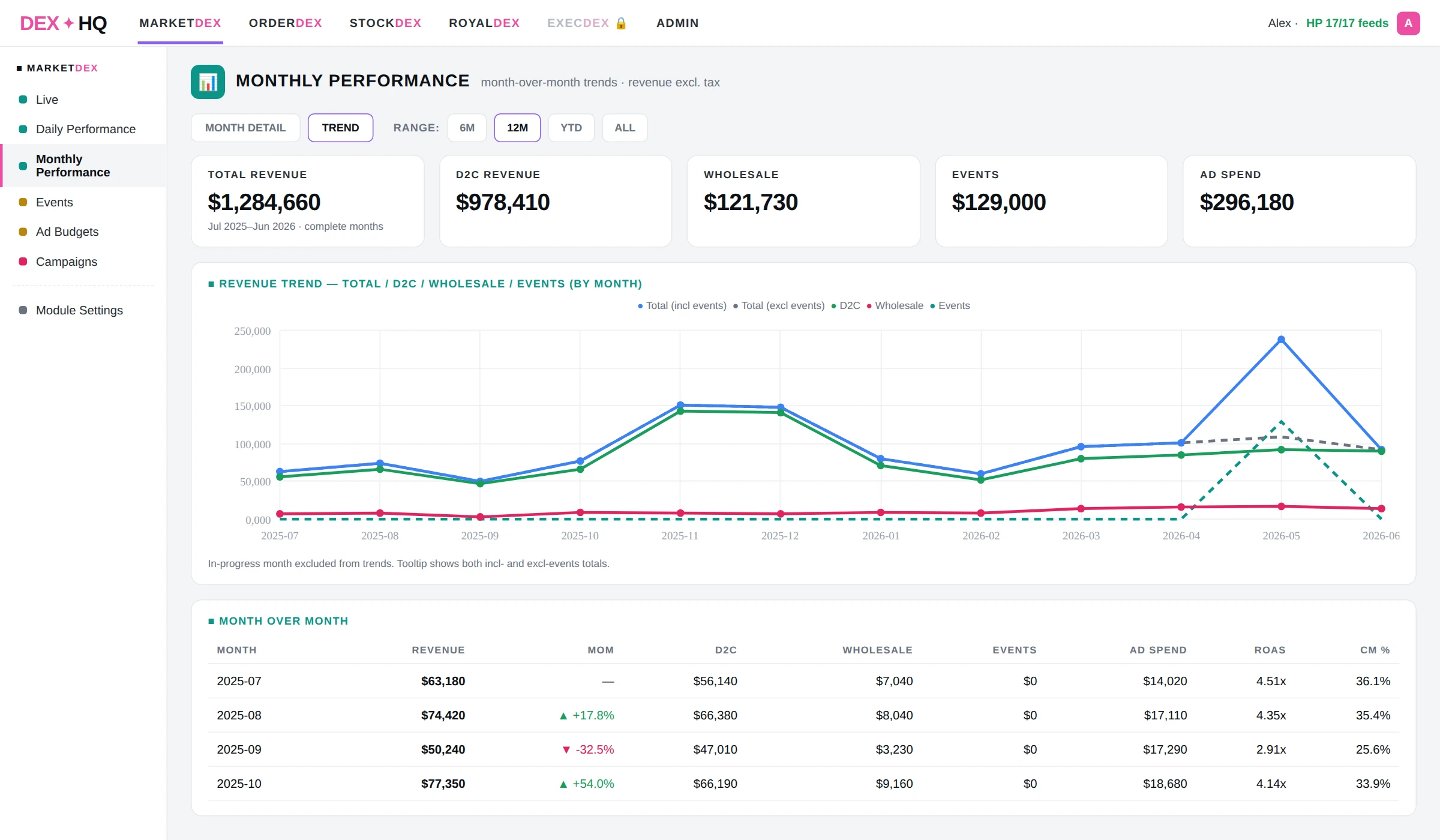
Channel revenue and ad performance — on the same revenue numbers your operations run on.

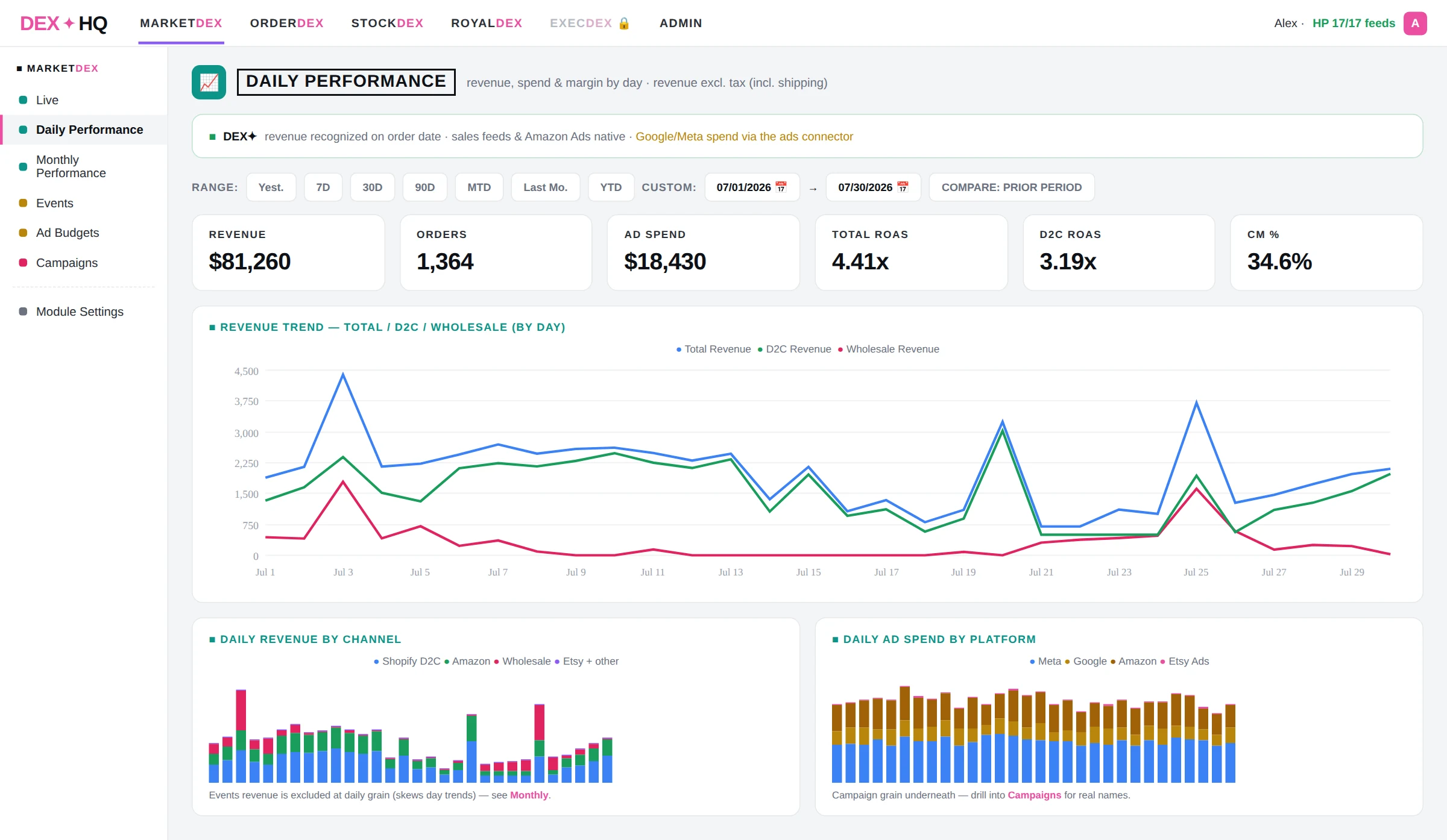
  • Daily & monthly performance by channel
  • Actual contribution margin — settlement fees, refunds, and shipping, not estimates
  • No more “which dashboard is right?”
Licensing & Royalties

RoyalDex

If you sell licensed designs, this is the module you've been faking in Excel.

  • Per-SKU rates, advances & recoupment, minimum guarantees
  • Statements generated from live sales data — not quarterly spreadsheet archaeology
  • Audit-ready PDFs your licensors will actually trust
Exists nowhere else
Your digital expert

Dex

The staff you haven't hired yet — working inside your real data, not a chatbot bolted on top.

  • Drafts product listings & marketing copy from your catalog
  • Watches your data feeds and flags what needs you
  • Writes the weekly operations brief you'd assign to an analyst
The difference

Things the big tools don't ship.

We benchmarked the leading inventory and operations platforms. These aren't premium add-ons elsewhere — they mostly don't exist elsewhere.

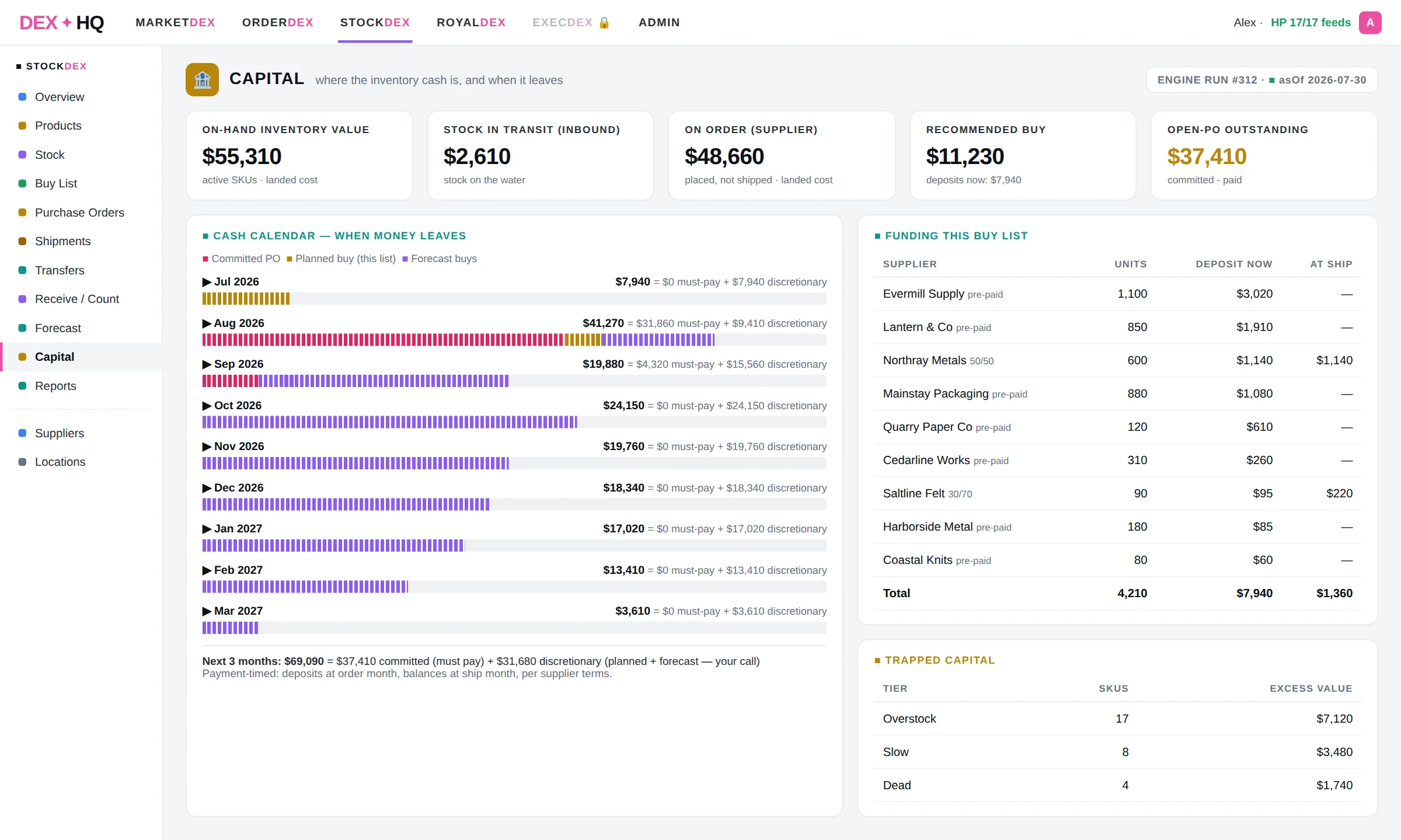
Payment-timed cash calendar

See cash leaving by month — supplier deposits now vs. balances at ship, committed POs, and forecast buys. Know your crunch months before they happen.

Stockout-corrected forecasting

Sold out for three weeks? Most tools read that as “demand dropped.” DexHQ knows the difference between no demand and no stock.

Accuracy you can check

A built-in backtest replays past forecasts against what actually happened. We show our error rate. Ask your current tool to do that.

Marketplace fee intelligence

Placement fees, aged-inventory and storage surcharges, replenishment thresholds — modeled into your buy and hold decisions, not discovered on your statement.

Every number explains itself

Open any figure and see why it is what it is — the inputs, the math, the run it came from. No black boxes.

Royalties from real sales

Recoupment and minimum guarantees computed straight from the facts layer — the licensing back office no platform at any price offers.

Real margins

Actual contribution margin.
Not an estimate.

Contribution margin, plainly

What's left from each sale after everything that sale cost you — the product, marketplace fees, shipping, refunds, the ads that drove it. It's the money that actually pays rent, payroll, and the next purchase order.

Top-line revenue means nothing if you can't pay your bills at the end of the month.

Most "profit dashboards" show you a modeled margin — a fee calculator, an averaged cost, an assumed return rate. It looks precise. It isn't real.

DexHQ computes contribution margin from what actually happened: marketplace fees from settlement data, refunds as they land, real shipping costs, real ad spend, landed cost per unit — per SKU, per channel, per month. When a fee changes or a refund hits, your margin already knows.

And because it's all one system, the buy list knows it too — reorder and dead-stock decisions weigh the margin you actually earn, not catalog theory.
Typical dashboard · estimated≈ 38%?
  • Fee table assumption
  • Averaged COGS
  • Modeled return rate
  • Ad spend in a different tool
DexHQ · actual31.4%
  • Settlement-level marketplace fees
  • Landed cost per unit
  • Refunds & shipping as they land
  • Ad spend on the same revenue rows

Figures illustrative. The point: the honest number is usually different — and it's the one worth running your business on.

Dex, your digital expert

The team you'll hire at $20M —
working for you at $2M.

Dex is calm, precise, and shows its work. It states what it did and what it found — plainly.

Operations analyst

Weekly briefs on what moved, what's stuck, and what needs a decision.

Demand planner

Seasonal forecasts, reorder points, and buy plans — with the math shown.

Licensing accountant

Royalty statements that compute themselves. Quarter-end stops being a project.

Listings copywriter

Product descriptions and channel copy drafted from your actual catalog data.

The promise

Built to be outgrown.

DexHQ takes you from $1M to $20M. Then it helps you leave.

Every good run ends one of three ways — and all three reward the same property: a business that runs on a system, not on you.

Scale into departments

Teams arrive, and teams buy their own tools. Your data stays yours and portable — clean exports, full history, accountant-ready statements. Everything comes with you.

Sell the business

Buyers discount brands that depend on the founder. A brand where operations run in a system, every number explains itself, and margins are actual, not estimated — that's a data room that's ready before the banker asks.

Stay lean forever

Or don't leave at all. A business that runs without you in every loop is one you can step back from — take the vacation; the briefs keep coming.

Whichever door you take, DexHQ's job is the same: get the business out of your head and into a system — where it's scalable, sellable, and yours.

Origin

Built by a founder, on a real brand.

DexHQ wasn't designed in a boardroom. It was built inside a working ecommerce brand — real purchase orders, real marketplace fees, real licensors waiting on real royalty statements. Every feature exists because running the brand demanded it. The forecasts are trusted with our own purchase orders. The cash calendar is checked against our own bank account.

— Miguel, founder

FAQ

Questions founders ask.

Who is DexHQ for?
Founder-led ecommerce brands roughly $1M–$20M+ a year, selling across Shopify, marketplaces, and wholesale. The real boundary isn't revenue — it's that a founder still runs operations. Lean, marketplace-heavy brands often stay founder-run well past $20M; as long as that's you, you're who this is for. If you sell licensed designs, you're exactly who we built this for.
What does being a beta tester involve?
Small batches, high touch. We connect your channels, seed your catalog, and tune the planning engine to your business with you — then you use it to run real operations and tell us what's wrong. In return, you shape the roadmap and lock in founding-member pricing at launch.
Do I have to use every module?
No. Start with what hurts — most brands start with inventory and purchasing — and turn on modules as you grow. They're better together (one source of truth), but nothing forces the full suite on day one.
Does it replace my whole stack?
It replaces the operational core: inventory planning, purchasing, order operations, performance reporting, and royalty accounting. It plays nicely alongside the tools you love for email, creative, and your storefront.
What happens when I outgrow it?
You leave with everything — full history, clean exports, statements your accountants and auditors can use. Graduation is part of the design, not a hostage negotiation.
We might sell the business someday — does this help?
It's built for that ending too. Acquirers look hard at founder dependency and at whether the numbers hold up under diligence. Running on DexHQ means your operations are documented by the system itself, your margins are actual rather than estimated, and your full history exports cleanly — the things a buyer's diligence team asks for on day one. We can't promise you a price; we can make sure the business is legible without you in the room.
How much will it cost?
Pricing will scale with your revenue, so the system grows with you instead of ahead of you. Beta testers get founding-member pricing — locked in.
Private beta

Apply to be a beta tester.

We onboard in small batches and reply personally. Brands selling licensed designs get priority.

No spam. We review every application and reply either way.